
Executive Resilience Under Pressure: Why Pausing Beats Pushing for Success
Executive resilience under pressure is not a trait some founders are born with while others miss out.
On the contrary, it is a skill that can be trained, tested, and strengthened over time.
A 2016 meta-analysis of stress research found that acute pressure impairs working memory and cognitive flexibility.
And these are the exact mental faculties founders rely on to make sound calls during a crisis.
Startup life multiplies this risk through compressed timelines, thin cash runways, and the constant weight of being the person everyone looks to when something breaks.

Executive Resilience Under Pressure-Power Of Pause
Additionally, the biology of stress does not distinguish between a term sheet renegotiation and a product outage at 2 am, because the nervous system reacts the same way.
Composure under high-stakes pressure is what separates founders who think clearly in a crisis from those who freeze, snap, or spiral.
This article covers why resilience matters more than ever for founders, what the evidence says about stress and decision-making, the daily habits that build lasting stability, and practical ways to recover quickly once pressure peaks.
Executive Resilience Under Pressure Starts With Self-Awareness
Founders often treat resilience as an act of will, meaning grit your teeth, push through, and don’t show weakness.
However, that framing gets the mechanics backwards.
Because executive resilience under pressure begins with noticing what is happening in the body and mind before reacting to it.
And not with forcing composure after the fact.
When a founder can name the physical signs of stress, such as a tightening chest, racing thoughts, and the urge to fire off a defensive email, they gain a few seconds of choice between stimulus and response.
And those few seconds are where good leadership decisions are actually made.
This distinction matters because founders often mistake speed for strength.
While firing back a reply within minutes can feel like decisive leadership, it is frequently the opposite.
It’s a nervous system reacting rather than a mind choosing.
And building the habit of a brief pause, even ten seconds before typing a response, creates room for the prefrontal cortex to catch up with the emotional reaction already underway.
As a result, over months, this small pause becomes a default setting rather than an effortful override.
And colleagues notice the shift in how a founder handles bad news long before the founder consciously tracks the change themselves.
Self-awareness is trainable.
Therefore, founders who build a habit of pausing before reacting to bad news report making fewer impulsive calls and recovering their footing faster after setbacks.
This is about widening the gap between feeling triggered and choosing how to act, and not about suppressing emotion.
A founder who reacts instantly to an investor’s terse email is operating from the same stress response as a founder facing a genuine emergency, even though the two situations carry very different stakes.
So learning to tell the difference, in real time, is the first building block of composure under high-stakes pressure.
And it is a skill, not a personality fix.
Why Founders Need Executive Resilience Under Pressure Every Day
Founders face a heavier cognitive load than most professionals in any given week.

Executive Resilience Under Pressure-Focus Clarity And Balance
Because they juggle product decisions, people problems, investor updates, and cash flow forecasts, and often with less sleep and fewer institutional supports than executives at larger, more established companies.
And this is why executive resilience under pressure is not a nice-to-have for founders. It is core infrastructure.
As a result, without it, the accumulation of small decisions wears down judgment long before any single crisis hits.
Research on cognitive function under stress backs this up. A systematic review published in the European Journal of Neuroscience examined how psychological stress and cortisol shape decision-making and found that stress reliably alters how people weigh risk and reward, particularly in tasks involving uncertainty.
Founders make uncertainty-based decisions constantly, such as pricing, hiring, and fundraising terms.
And these mean the stakes of unmanaged stress are higher for them than for most roles.
Additionally, a separate meta-analysis published in Frontiers in Psychology confirmed that acute stress measurably impairs working memory and cognitive flexibility, the two capacities most needed to pivot a strategy or hold multiple scenarios in mind at once.
While none of this means founders are doomed to poor judgment under pressure, it does show that pressure has to be actively managed rather than ignored.
Because the cost of ignoring it shows up directly in the quality of decisions a founder makes.
The compounding nature of founder stress is often underestimated.
A single high-stakes negotiation is manageable in isolation, but founders rarely face just one.
Instead, they face a continuous sequence of them, stacked across a single week with little recovery time in between.
And each unmanaged episode leaves a residue of depleted cognitive resources for the next one.
Consequently, founders who appear to “hold it together” for months can still hit a wall suddenly and without obvious warning.
Therefore, treating resilience as an ongoing practice, rather than a reserve to draw on only when things go wrong, is what prevents that slow accumulation from reaching a breaking point.
Executive Habits That Sustain Founders Long Term
Composure under high-stakes pressure is built through small, repeatable habits rather than one dramatic act of willpower.
And founders who sustain performance over years, not just through a single funding round, tend to protect a handful of non-negotiables.
These include consistent sleep, a clear line between reversible and irreversible decisions, and structured time to think without interruption.
Because treating every decision as equally urgent is one of the fastest routes to burnout.
Since it means the nervous system never gets a chance to downshift.
George Kurtz, CEO of CrowdStrike, spoke publicly about this after the company’s 2024 global outage forced a rebuild of trust with customers.
He described resilience as something that has to be designed into daily operations rather than summoned only in a crisis, telling reporters that “pursuing resilience is not optional” for leaders navigating sustained pressure.
His response on building resilience into everyday systems and decisions rather than treating it as a personality trait for the worst days mirrors what founders can apply at a much smaller scale.
And this is to build recovery into the calendar before a crisis forces it.
McKinsey research on organizational leadership found that companies with decisive leaders are 4.2 times more likely to be rated organizationally healthy than their peers.
So this suggests that the habit of deciding, even imperfectly, protects performance more than waiting for certainty ever does.
For founders without the infrastructure of a large executive team, the same principle applies at a smaller scale.
Protecting a fixed thinking block on the calendar, setting a rule that irreversible decisions get slept on overnight, and building a short daily routine that signals the transition out of “founder mode” all function as the equivalent of Kurtz’s systems-level approach.
Moreover, none of these habits requires significant time or budget.
Instead, what they require is treating them as fixed commitments rather than optional extras that get dropped the moment the calendar fills up.
And this is usually the exact moment they are needed most.
How Leaders Stay Calm Under Pressure And Recover Fast
Staying calm in the moment matters, but recovery afterwards matters just as much.
Executive Resilience Under Pressure-Small Habit Strong Leader
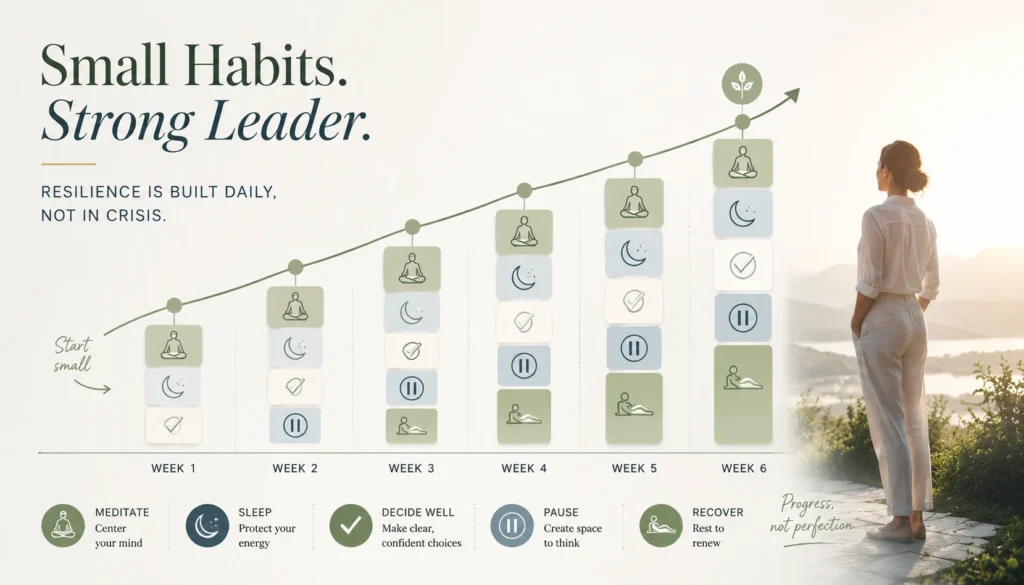
Founders who bounce back quickly from a bad week tend to build in deliberate off-ramps: a short walk between a difficult call and the next meeting, a five-minute reset before responding to an inflammatory email, or a fixed point in the week reserved for reflection rather than execution.
Furthermore, these are not indulgences.
Instead, they are what allow the nervous system to return to baseline so the next decision is not made from a depleted state.
Teams also take their emotional cues directly from the founder.
Because a leader who stays visibly steady during a setback signals safety to the people around them.
And this keeps the team solving problems instead of managing anxiety.
However, this does not mean masking every difficulty.
Because founders who pretend nothing is wrong often erode trust faster than those who are honest about a challenge while staying grounded in how they respond to it.
And the goal is the capacity to feel the pressure, name it, and still choose a considered response rather than a reactive one, not invulnerability.
Over time, this capacity compounds, and each recovered setback makes the next one easier to weather.
And this is the entire point of building the skill deliberately rather than hoping it shows up when needed.
Conclusion
Founders rarely get to choose when pressure arrives, but they do get to choose how prepared they are to meet it.
And the evidence is consistent: unmanaged stress erodes the exact cognitive functions founders depend on most.
On the contrary, deliberate habits such as self-awareness, structured recovery, and decisive action, even without full certainty, protect judgment over the long run.
Therefore, building this capacity is not about becoming immune to difficulty.
Instead, it supports in creating enough space between pressure and response that a founder can lead from clarity rather than reactivity, deal after deal, crisis after crisis.
Next Steps: Let’s Talk
If you’d like support with this, get in touch. I offer a 15-minute clarity call where we can connect and explore your requirements. Book here.
About the Author
I’m Maniesha – a performance capacity coach with over 20 years’ experience across sectors and 1,000+ clients across coaching, counselling and assessment, working with founders, leaders and teams under pressure.
I help people think more clearly, decide faster, and lead without the friction that burns people out.
My work spans solopreneurs to multinational organizations, integrating evidence-based modalities with somatic tools to build performance capacity that scales with you.